Film footage by my father, Alastair Edwards (1936-2010), in Nadi and around Viti Levu in 1976.
It’s from my parents’ honeymoon, a couple of years before I was born.
There was no sound, so I’ve added a soundtrack from Ruasagavulu, which Dr Emit Snake-Beings and I recorded in Suva decades later.
My Dad’s interest in film (then video) and photography was one of the key influences on my own travel and videomaking. He was doing this long before youtube or instagram!
Animated visuals, with electric guitar loops, one-stringed bass, and drums – the opening track from the ‘Ngumbang‘ album (get the free download) – w/ Emit Snake-beings & Nat da Hatt
“It’s lo-fi, organic and about as eclectic as one could manage. Kind of reminds me of Nick Cave if he had grown up in Timaru. No pretentious American accents or catch phrase choruses, just a bunch of people making music. A little beauty!” – NZ Musician, August/September 2002
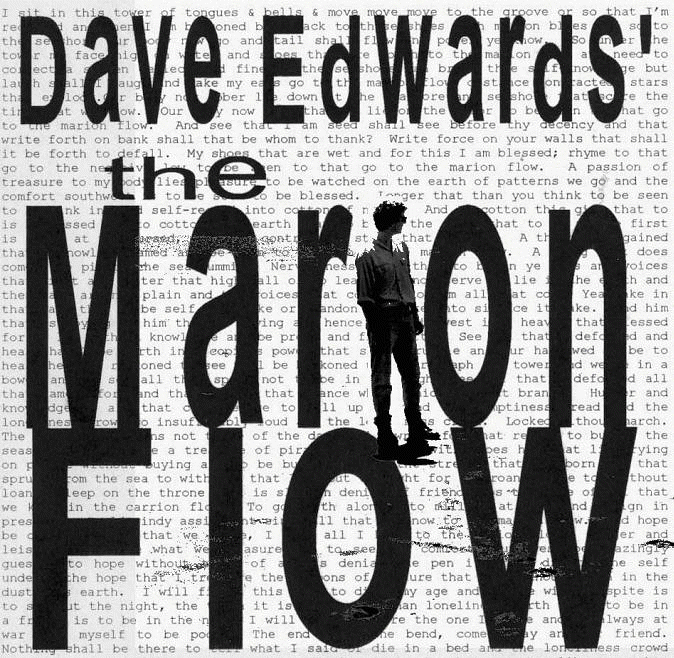
The Marion Flow was originally a longer album which spanned recordings from New Plymouth in 1999 and Wellington in 2001.
In 1999, aged 20, I’d left New Plymouth, a large rural town, where I grew up, and moved to Wellington, New Zealand’s capital city, where I’d been born and where my early pakeha settler ancestors had lived in the 19th century. The Marion Flow reflects this journey, geographically, sonically and spiritually.
By the time the opportunity arose to finish recording the Marion Flow I’d been thoroughly immersed in the Wellington free jazz and avant-garde music scene, and was very fortunate to have help from some of the top players there. I’d never studied music at school or been in a conventional band, and was out of my depth technically… so working around my limitations became a spark to creativity.
I’ve now reissued the two halves of the album separately – to emphasise the sense of time and place, and stylistic evolution, and to re-present them more concisely for the short-attention-span 21st century.
“Edwards’ music is often a sculpture rather than a melodic composition. Within this chosen form, amongst all the writings rantings & poetry there’s much difficult pleasure to be had for the musically adventurous.” – Brent Cardy, Real Groove, July 2002
Tracklist
1.
Seafriends 03:07 Dave Edwards – acoustic guitar, vocal Paul Winstanley – fretless bass Chris Palmer – electric guitars Chris O’Connor – drums
2.
A Wedding 03:48 Dave Edwards – electric guitar, piano innards, canvas sheet, vocal
3.
A Visit to the Beehive 00:45 Dave Edwards – acoustic guitar, vocal Simon O’Rorke – drums
4.
Monkeys with Typewriters 03:30 Dave Edwards – electric guitar Chris Palmer – electric guitar Simon O’Rorke – percussion
Seafriends (instrumental mix) 04:05 Dave Edwards – acoustic guitar Paul Winstanley – fretless bass Chris Palmer – electric guitars Chris O’Connor – drums
“It’s lo-fi, organic and about as eclectic as one could manage. Kind of reminds me of Nick Cave if he had grown up in Timaru. No pretentious American accents or catch phrase choruses, just a bunch of people making music. A little beauty!” – NZ Musician, August/September 2002
The “hit single” Banana Wizard was released on a compilation of Taranaki music and had some student radio airplay around the country… about the extent of my commercial success to date.
I was also opening my ears and mind to more experimental sounds, and moving beyond conventional pop song structures.
At the same sessions we recorded free improvisations, which Paul later overdubbed and rearranged into
Taranakiimprovisedrock/noise deconstruction with sputtering synth, air-sucking turntables, didgeridoo and sundry toys providing layers of surreal abstraction (1999)
“after recording tracks for The Marion Flow at Wafer HQ in New Plymouth, an ad hoc group of associated locals assembled to record… the only rock references here come from the guitars… throw in some spoken word and a special guest appearance by N.P. record mogul Brian Wafer on vacuum cleaner and the dAdApApA nova had blazed and fizzled in the blink of an eye” – Eden Gully
& then I got to the capital city, and was suddenly a small fish in a bigger pond…
Part 2, Wellington
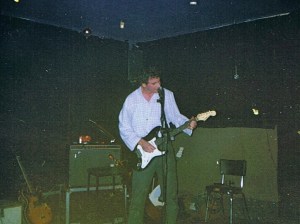
Dave Edwards, at Bar Bodega, Wellington NZ, 1999
Here’s what I sounded like around the time I arrived in Wellington – this solo postpunk set at Bar Bodega, opening for Chris Knox, was preserved (in lo-fi, a 90s aesthetic):
But apart from songs I also fell under the influence of the burgeoning avant garde and free improv scene in Wellington.
This was centred around a venue called the Space (later Fred’s and then the Pyramid Club)… the dissonant flipside of the more popular smooth Pasifika/jazz sound the city became known for (Fat Freddy’s Drop et al).
Although way out of my depth technically, I met up with improvising percussionist Simon O’Rorke, and jazz-trained players including Blair Latham and Jeff Henderson to make
A few years ago I wrote a chapter of Jazz Aotearoa, a book about New Zealand jazz music history, discussing the free improvisation and avant-garde jazz scene in Wellington at the turn of the millennium.
in the non-idiomatic idiom in Norway is a collection of improvised instrumental music with some of the musicians in that scene, from the point of view of my own attempts as an untrained outsider to fit in with these advanced jazz players.
The title is a reference to Simon’s house on Norway Street, where the recordings took place. The ‘non idiomatic idiom’ suggests the paradox that improvising non-idiomatically (eg in an original personal style without reference to any genre – playing neither jazz, nor rock, blues, reggae, classical etc) is an idiom in itself.
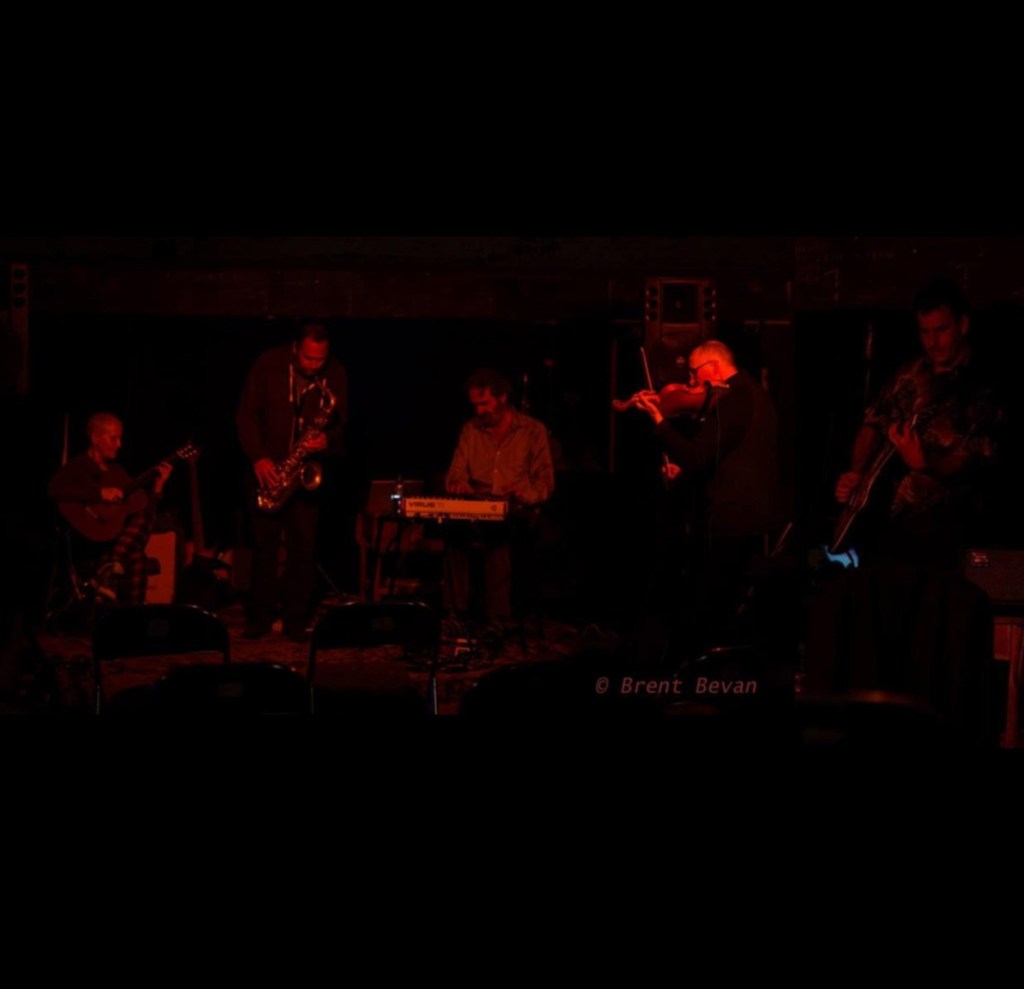
Confluence Quintet: (l-r) Julie Bevan, Michael Hall, Simon O’Rorke, Chris Prosser, Dave Edwards
“It’s lo-fi, organic and about as eclectic as one could manage. Kind of reminds me of Nick Cave if he had grown up in Timaru. No pretentious American accents or catch phrase choruses, just a bunch of people making music. A little beauty!” – NZ Musician, August/September 2002
As the sophomore fiffdimension release (following 1998’s Scratched Surface), The Marion Flow began to mix more experimental elements alongside the songwriting. It shows an evolution in ambition and production values, and a more complex & impressionistic lyrical style.
“I sit in this tower of tongues & bells, & move to the groove
Or so that I’m reckoned, & then I am beckoned
Back to these shoes, nigh marion blues
And so to the seashore our body now go, & tale shall flow & power ye know…” – The Marion Flow
In 1999, aged 20, I left New Plymouth, a large rural town, where I grew up, and moved to Wellington, New Zealand’s capital city, where I was born. The Marion Flow reflects this journey, geographically, sonically and spiritually.
The Marion Flow was originally a longer album spanning recordings from New Plymouth in 1999 and Wellington in 2001. I’ve now reissued the two halves separately – to emphasise the sense of time and place, and stylistic evolution, and to re-present each more concisely (for the short-attention-span 21st century).
“Edwards’ music is often a sculpture rather than a melodic composition. Within this chosen form, amongst all the writings rantings & poetry there’s much difficult pleasure to be had for the musically adventurous.” – Brent Cardy, Real Groove, July 2002


 fiffdimension