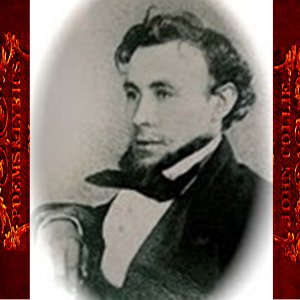
an adaptation of the book “Poems and Lyrics (in the English and Scotch dialects)“
by John Middleton Collie (1834-1893) of Boyndie, Scotland,
with music by his descendants in New Zealand, between 2018-2025.
Listen
Start with this short 5-track sampler EP:
It offers a brief introduction to some of the literary and musical themes (eg nature, alcohol, mortality, Scotland, emigration), and works as a standalone mini-album.
The full double-album goes deeper & broader – with 44 tracks across
Poems and Lyrics
(in the English
and Scotch Dialects).
- Listen
- Poems and Lyrics
- About the poems
- Musical adaptations
- Collaborators
- The making of the album
- Critical reception
- Tracklists
- Live versions
- The book’s introduction
- Later history
- Other pieces inspired by my ancestors:
- Further listening: Acoustic (yin) 1998-2023
About the poems
In 1856, two years before he emigrated to New Zealand, my great-great-grandfather John Collie (1834-1893), of Boyndie, Scotland, wrote and self-published a book. It set a DIY outsider art precedent for his descendants. The book is now available free online.
Like his more famous countryman (and influence) Robert Burns, John Collie wrote in both English and Scots. He could be melancholy or humorous, plain-spoken or obscure. He had a gift for rhythm, rhyme, and musicality of his words.
His writing in English tends to be more formal, with grand themes;
“T’were a noble sight to see the mighty men of old, who bled that their countries might be free from the tyrants’ fatal hold – yet I’d deem it a nobler sight by far to behold the sons of the harp & lyre!” – An Hour Among the Poets
whereas the Scots poems are more down-to-earth, with bawdy humour.
“But a slee pauky loun came cannily up , An ‘ he made a proffer o ‘ marriage ; Jean sprang to the bait , like the crack o ‘ a whip , An ‘ awa they gaed bir in a carriage . The poets may sing , and priests may pray , An ‘ the clashin ‘ auld wives may clatter ; But the laddie cared nought , and Jeanie’s away , So that puts an end to the matter .” – Did ye ken sportin’ Jeanie?
Some of his themes include:
- Scotland (“My Native Land“, “The Thistle“),
- nature (“Solitude“, “Nature“, “Address to a Linnet while Singing“),
- the sea (“To the Ocean“),
- the seasons (“The Blast of a Wintry Day“, “To a Snowdrop“, “Sonnet on Summer“, “Autumn“),
- friendship (“Epistle to Mr John Syme, Rafford“)
- youthful romance (“Lines written on receiving an anonymous letter from a young lady“, “The Kiss o’ a Loun” ),
- unrequited love (“Heard ye e’er o’ Donald Ben?“, “Farewell to Thee, Charming Deceiver“)
- marriage and domestic life (“What de’il’s the matter with ye Meg“, “The Thing’s Baith Clear and Plain“, “The Mother to Her Son“)
- death (“The Dying Monarch“, “Death“),
- bereavement (“Adieu to Tweedside“, “The Exile’s Return“),
- alcohol (Here’s a Health to My Cronies“, “I Met Four Chiels“, “By my faith sirs, this canna lang dee“, “The Coggie” – clearly a favourite theme!),
- the Devil (Auld Satan when ye first gae through“)
- English colonialism (“Scotland’s Grievances“, “The American Chief’s Song of Defiance“),
- war (“Lines on the Death of Lord Raglan“, “The Wounded Hero“),
- literary immortality (“An Hour Among the Poets“),
- new technology (“Lines written on Mr James Blain’s, photographer. visit to Coldstream“)
- emigration (“The Land of my Youth“, “The Emigrant’s Reflections“ – in his case he moved to New Zealand two years later),
Musical adaptations
I‘ve been setting some the poems to music over the past few years – along with some of his other descendants: my nephews Hans and Rhys Landon-Lane, my niece Céleste Rochery, and my sister Megan Edwards-Rochery. Thanks also to my cousin removed Rosemary Bromley, for historical research – truly a multi-generational endeavour!
A starting point was the “& Lyrics” in the title. It suggested they were always intended to be set to music.
Most of the album is played on acoustic stringed instruments, with simple diatonic chord progressions. This approach was chosen to reflect the pre-modern poetry, and to highlight the acoustic folk influences of fiffdimension – in contrast to our noisier electric albums.
“If aught can claim a spirit’s admiration,
Sure it must be this beautiful creation“
– John Collie (1834-1893)
Videos
Solitude
“in a daring move, the first track (Solitude) is an unconscionable 12 minutes long, which would likely alienate the goldfish memory of the Spotify listeners”
Peter-James Dries, muzic.nz
The first poem in the book was recorded solo in 2020, during Covid lockdown, and first released on Campbell Kneale’s Psi-solation compilation. This new contemporary solitude added another layer of meaning to the 19th century one.
“And thou, o solitude, my dearest friend, with thee I ever feel a chief delight.
Thy solemn stillness captivates my mind, and shows me mankind in a clearer light,
and points me out their many hidden snares, to catch my human frailties unawares”
Traditional melodies
In some cases, we’ve fit the words to the tune of traditional Celtic songs. Several work as alternative lyrics or ‘responses’ to better-known songs by Robert Burns.
“My Native Land” was the first piece recorded, by Céleste Rochery (John Collie’s great-great-great-granddaughter) in 2018. She noticed that the words fit the traditional Celtic tune “Star of the County Down“. Her insight sparked the rest of the album.
“My native land, my native land, to sing thy praise I’ll try; for I nae ither garland have around thy brow to tie”
The Wounded Hero
The final poem in the book, and one of the last recorded (in July 2025), is The Wounded Hero. It describes an anonymous soldier dying on a battlefield. While most of the album is acoustic, this closing track is played on distorted electric guitar – to evoke the chaos of battle, and to close the album with a sonic bridge back to the modern era.
It’s played to the tune of Robert Burns‘ patriotic anthem Scots wha hae, to which it ‘replies’ with more of a ‘horror of war’ theme.
“He was an aged chieftain, his heart was stern and true; he dealt the fiery darts of death on bloody Waterloo. But on the battle field he lay, low weltering in his gore; he saw death in a light til now he’d never seen before”
Collaborators
Clever Hansel (Hans Landon-Lane)
John Collie’s great-great-great grandson Hans plays ukulele, accordion, melodica. He takes lead vocal on Sonnet on Summer, The Mother to her Son, and The Land of my Youth.
His brother Rhys Landon-Lane contributes guitar and vocal to By my faith sirs, this canna lang dee.
Megan Edwards-Rochery
John Collie’s great-great-granddaughter Megan is an actress, best known to international audiences as Mrs Proudfoot in Lord of the Rings.
She gives spoken-word readings of Young Johnnie o’ the Birken Shaw, Epitaph on a Pedlar, Celebrated for his Swiftness, and What De’il’s the matter with ye Meg?
Céleste Rochery
John Collie’s great-great-great-granddaughter Céleste made the first recording for the album, “My Native Land“, in Paris, France in 2018. She noticed that the words fit the traditional Celtic tune “Star of the County Down“. Her insight sparked the rest of the album.
The Troubled Times‘ crossover
Most of the album uses acoustic instruments and family members. However, The Troubled Times (my Wairarapa garage rock trio with Antony Milton and David Heath) make a guest appearance. We perform an epic electric swamp-blues arrangement of The Dying Monarch. It was recorded at the session for A Second Sun in 2022.
It’s a key crossover track, that links the various spoken word, electric improv, and folk strands of my music. In this case, an electric arrangement seemed to add a ‘kingly’ majesty, and pathos as the monarch discovers the limits of his worldly power.
“The monarch ceased. The courtier train shook, muttered, gazed and shook again.
They saw life’s dying embers fade, they felt the sting of horror’s blade.
Before them lay a lifeless form, which once with life had passions warmed.
The hand was stiff which oft had reigned, the warhorse and the prisoner chained.
A lifeless lump of senseless clay, the stern despotic monarch lay.” – John Collie (1834-1893)
Dr Emit Snake-Beings
The other “odd one out” track with a guest collaborator is An Hour Among the Poets , featuring avant-garde multimedia artist Dr Emit Snake-Beings. He was an early influence on my work; we later met, and collaborated on the duo albums Ngumbang and Ruasagavulu in the 2010s.
The poem is a visionary sequence in which the narrator witnesses a procession of great poets throughout history. The music is an experimental sound collage, built from overlapping past live performances with Snake-Beings, designed to evoke the surreal, layered atmosphere of a dream.
“The mighty” Antony Milton also makes a cameo – with a single electric guitar chord representing his namesake, the poet John Milton.
“The mighty Milton first me passed; immortal Shakespeare followed fast; before me lofty Chaucer stood like some gigantic sculptured god […] next in russet garb appeared immortal Burns, auld Scotia’s bard.”
The making of the album
is discussed in the Radio Dolby 89.6 FM interview:
Significance
For me, Poems & Lyrics by John Collie is one of the more significant fiffdimension albums, as it is:
- a major work-in-progress;
- an inspiration for new music (a mostly folk style seemed fitting – toning down my noisier experimental tendencies, as a personal challenge and to reflect the pre-modern lyricism);
- a family precedent for DIY outsider art, that puts fiffdimension in a deeper context;
- an exploration of my pākeha whakapapa (European genealogy) and culture, as a non-Māori New Zealander);
- the other side of my family are 3rd generation Scottish and Northern Irish immigrants to NZ- making Scottish the largest proportion of my ethnic mix (the rest is English, Portuguese, and Welsh);
- a contribution to New Zealand and Scottish history and literature;
- further reading and listening for anyone interested in the works of poets such as Robert Burns, Hugh MacDiarmid, Sir Walter Scott, James Macpherson, and Robert Louis Stevenson (Scotland); or Thomas Bracken, William Colenso, Alfred Dornett, and James K Baxter (NZ);
- a window into the culture of 19th century Scotland, and a vicarious travel experience
- (plans to visit Scotland in 2020 were ruined by the pandemic, and going there now is prohibitively expensive); and
- a fine example of the beauty and musicality of the English (and Scots) language.
Critical reception
Review by Peter-James Dries, muzic.nz
“No one will remember you in 169 years. Simple fact, really.
By successfully separating the worker from the means of production, the names of the average person are stamped on nothing. If you didn’t leave anything behind, is there proof you were here? Just another faceless worker for another forgotten company, if you’re even lucky enough to be employed in this yet-unnamed depression era. A number in a database within the compromised network of a failing dictatorship.
As naught would likely remember that one son of John Collie and Mary Middleton.
If John Middleton Collie hadn’t self-published that book in 1856…
Were it not for the resurrectionist work of descendant, David Edwards…
If only Edwards hadn’t self-published an album of tracks based on the poetry of one of his 16 great-greats…
If it wasn’t for the great Kiwi pastime, popular amongst bored couples and the dying breed that is musicians; DIY.And if there is one acronym that describes the music of David Edwards succinctly, it would be DIY.
Taking the DIY ideals, the name, and the lyrics straight from ancestor Middleton Collie’s book itself, the new Edwards release, Poems & Lyrics by John Collie (1856), features appearances from other great-greats and great-great-greats. Recorded over 7 years or so, Poems & Lyrics is available in at least four versions; a five-part taster, 20 tracks in English, 24 in the Scotch dialect, and then all 44 together. From experience, it helps to approach the albums in the order above, for my fellow lost.
The album, or albums, are deeply personal, and extremely niche, to the point as a whole they would really only be appealing to a select few; friends, family, Arts majors, fellow descendants, the Scottish, folk musicians, fans of poet Robbie Burns […] Obviously, a natural rebellion against this highly curated (read as meaning fake) post-social media world.
[…] What that sounds like in this case is a collage of tracks spanning psychedelic rock (The Troubled Times – The Dying Monarch ), acoustic free-verse (Autumn ), reappropriated traditional folk standards (The Bard’s Lament), and a smattering of spoken word (Young Johnnie o’ the Birken Shaw), occasionally over bagpipes (Epitaph on a Pedlar, Celebrated for his Swiftness ). The record is brilliant in flashes, frustrating in others, but never impersonal. There are moments of greatness, like the Clever Hansel additions and Celeste Rochery’s My Native Land , and equally moments of confusion. Constructed like a patchwork quilt, yet raw and almost unedited, much like history itself.
Undeniably it’s a novel concept, a unique idea, and a wholesome project for a proud family. DIY isn’t just tradition; it’s resistance to forgetting, a way of leaving scratches in the dark even when no one’s listening. Like John Middleton Collie of Boyndie, Scotland before him, Edwards has made his smear in the footnotes of history, ripe for resurrection in 2194. ” – Peter-James Dries, muzic.nz
Tracklists
in the English dialect
| 1. | Solitude 11:58 |
| 2. | The American Chief’s Song of Defiance 02:12 |
| 3. | The Exile’s Return 03:46 |
| 4. | Give me the Golden Cup of Love 03:26 |
| 5. | w/ Clever Hansel – Nature 03:12 |
| 6. | Clever Hansel – Sonnet on Summer 03:18 |
| 7. | Autumn 03:36 |
| 8. | Lines on the Death of Lord Raglan 03:09 |
| 9. | The Troubled Times – The Dying Monarch 07:48 |
| 10. | To a Snowdrop 02:01 |
| 11. | To the Ocean 03:37 |
| 12. | The Bard’s Lament 02:19 |
| 13. | Clever Hansel – The Mother to her Son 03:35 |
| 14. | Farewell to Thee, Charming Deceiver 03:31 |
| 15. | Adieu to Tweedside 02:52 |
| 16. | Address to a Linnet while Singing 03:34 |
| 17. | Clever Hansel – The Land of my Youth 03:57 |
| 18. | The Emigrant’s Reflections 03:29 |
| 19. | fiffdimension + snakebeings – An Hour Among the Poets 05:43 |
| 20. | The Wounded Hero 03:59 |
in the Scotch dialect
Live versions
in recent years I’ve included John Collie’s pieces in my live solo sets – examples appear on:
Live 2025
(I Met Four Chiels” / “Death “)
Live 2022-24
(“I Met Four Chiels” / “Auld Satan when ye first gae through“)
and
Live 2019
(“The Blast of a Wintry Day” / “The Land of My Youth” / “Here’s a Health to My Cronies“)
The book’s introduction
WHEN authors offer to the world anything in shape of a book , if not necessary , it is at least customary , with them to have what is termed a Preface . I confess it is more for custom’s sake than from any necessity on my part , which has prompted me to have such . And with a trembling hand I launch my tiny vessel into the troubled ocean of literature , where many a noble craft has been shattered to pieces .
I am too conscious of my own inferiority to flatter myself with public plaudits ; for works of deathless worth in comparison with my unpresuming volume have been buffeted amidst the rocks of criticism until they fell asleep in the arms of oblivion to be heard of no more . Such has been , and still is the fate of books , for no sooner does an author come before the public than a number of individuals , called critics , start up in every direction , not so much with the intention of holding up errors to public censure , but simply to knock down authors .
Should any of the above – mentioned sons of learning consider the following pages worthy of a review , I would have them to bear in mind that these productions were composed under anything but favourable circumstances ; they are the product of a young man who , as fortune would have it , received but a limited share of education , and had to struggle against the jibes and jeers of men. I mention these facts , not with the supposition that the mere relating of them is to excite praise , yet it may be the means of arresting the iron voice of censure .
I beg leave to inform my readers that mercenary motives never prompted me to become author , for they who wish to shine in the wealthy world must needs put but little dependence on the sacred Nine . But the warm reception a number of my pieces have met with , and the promptings of my own ambition , have caused me to collect the effusions which I from time to time have written into the form in which they now appear .
I am conscious , if MERIT be due , it will be freely given , and I will willingly bow to honest and unprejudiced criticism . I have studied no particular model for imitation , and in some of the pieces a casual resemblance may seem to appear with the works of other authors whose strains and ideas most agreed with my taste , yet no such thing as plagiarism entered my brain .
I would here take the liberty of tendering my warmest thanks to my numerous subscribers , and hope they will never have to repent affording me their patronage and encouragement
– JOHN COLLIE . BOYNDIE , 19th Aug . 1856 .
——————————-
Later history
In 1858 John Collie emigrated to New Zealand, arriving in Dunedin aboard the Jura.
He first settled in Dunedin. Then, following the death of his first wife Elizabeth Christie, spent his later years in the Wellington region.

He worked on infrastructure projects, including the original railway line across the Remutakas in the 1870s.
Nowadays the railway line is a walking and cycling track. Its history is documented in the Fell Locomotive museum in Featherston.
Unfortunately, no later writings by John Collie in New Zealand are known to survive. But he appears in the historical records – for his work on the Rimutaka incline project, and for being fined for public drunkenness and letting animals wander.
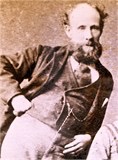
He died in 1893, from a tree-falling accident in Kaitoke, and is buried in Karori Cemetary in Wellington.
Descendants
I am descended from John Collie and his second wife Margaret Stevenson (another Scottish immigrant) via their daughter Rose.
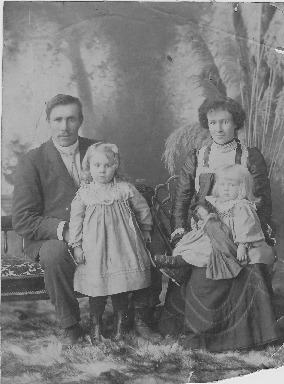
Rose married Percival Edwards (grandson of John ‘Totara Jack’ Edwards).
They (my great-grandparents) farmed around Kahutara, near Featherston (where I now live), in the early 20th century.
My nephew Hans Landon-Lane and niece Celeste Rochery are part of the next generation of our family.
Other pieces inspired by my ancestors:
- The Ballad of William Knife (John ‘Totara Jack’ Edwards (1809-1889), from York, England),
- Ilhas Atlanticas (Manuel Bernard (1847-1928), from Flores island, Portugal); and
- Fiji 1976, a soundtrack to a film by my father, Alastair Edwards (1936-2010).
Writing new poems in the ‘voice’ of John Collie could be a potential future project. These would be based on his later life in New Zealand. Then, set them to music. These could represent the works he might have written, had he continued..?
Further listening: Acoustic (yin) 1998-2023
A compilation of original acoustic ‘poems & lyrics’ (and instrumentals) by fiffdimension – most of it created before I was aware of the precedent set by John Collie! Interesting to compare the Victorian and postmodern era sensibilities…
 fiffdimension